Low oil pressure does not automatically mean a failed oil pump. For a heavy truck awaiting repair, the useful question is what evidence separates a faulty indication from an oil-supply problem, internal leakage or pump damage.
That distinction determines what to inspect, which parts to order and what must be corrected before the engine returns to work. A replacement pump should follow the diagnosis, not become an unreliable way of testing a guess.
Table of Contents
Treat an Active Pressure Warning as a Stop Signal
When a low oil pressure warning appears during operation, move to a safe stopping place and shut down according to the vehicle’s instructions. Do not keep driving because the engine still sounds normal, or repeatedly restart it to see whether the warning disappears.
The diesel engine fundamentals handbook explains that loss of lubrication pressure can cause seizure. Its general principles do not replace the shutdown instructions for your engine.
This guide supports workshop assessment and parts purchasing. It is not permission to run an engine with suspected oil starvation. A qualified technician must decide whether controlled testing is safe.
What Low Oil Pressure Actually Tells You
Oil level describes the quantity in the sump under specified checking conditions. Oil pressure describes a condition at a particular point in the lubrication circuit. A full dipstick reading does not prove adequate delivery to the bearings.
The pump supplies oil through a circuit that includes galleries, lubricated components and regulating devices. Pressure depends on their interaction with oil viscosity and operating conditions. Therefore, low oil pressure identifies a system concern, not the location of the defective component.
The heavy-truck lubrication diagnostic task list separates pressure verification, sensor checks, pump inspection and regulating-valve assessment. Keep those decisions separate in the repair record, too. “Warning present” and “pump rejected after inspection” are not equivalent findings.
Record the Pattern Before Authorizing Parts
Describe when low oil pressure was first observed. Preserve existing fault records, displayed readings and maintenance information without running the engine again simply to collect more data.
Include the engine speed, available temperature information, operating load and whether the event followed an oil change or rebuild. The following observations help organize an investigation; none proves a particular failure.
| Observed pattern | Question for the workshop | Useful supporting evidence |
|---|---|---|
| Warning immediately after service | What changed in the oil, filter, connections or assembly? | Service record, installed references and pre-service condition |
| Warning only when hot at idle | Does independently measured pressure meet the specified hot-idle requirement? | Actual speed, oil temperature and applicable limit |
| Abrupt drop during work | Was there oil loss, drive damage or another sudden system change? | Driver account, shutdown record and safe visual inspection |
| Unstable displayed reading | Is the fluctuation present at an independent measuring point? | Instrument comparison and electrical inspection findings |
| Warning after engine rebuilding | Which lubrication-related components were disturbed or replaced? | Assembly measurements, component list and commissioning record |
For low oil pressure inquiries, write “not measured” where evidence is missing. A blank record should not be converted into an assumed normal result.
Verify the Reading Independently
A dashboard warning and a scan-tool value may come from the same sensor. Agreement between them is not necessarily independent confirmation. Identify what each display actually represents before interpreting it.
Where the engine’s diagnostic procedure requires it, have the workshop use an appropriate independent pressure instrument at the specified test point. The technician must first establish safe testing conditions. Do not warm up an engine with suspected starvation merely to obtain a hot reading.
A useful low oil pressure report identifies the instrument, test location, units, engine speed, oil temperature and applicable specification. Check that the instrument’s range and uncertainty are suitable. Measurement traceability guidance makes clear that traceability alone does not establish fitness for a particular measurement.
If measured pressure meets the correct requirement while the warning remains, investigate the sensing and indication circuit using the applicable wiring information. If the low reading is confirmed, continue with lubrication-system diagnosis. Neither branch justifies replacing a component solely because its name appears in a fault description.
Consider a hypothetical comparison between two trucks reporting low oil pressure with full sumps. On one, a valid independent measurement meets the specified requirement while the displayed value is wrong. On the other, both readings are below the applicable limit. The first needs an indication-system investigation; the second needs a lubrication-system investigation. An identical driver complaint therefore leads to different repair work, and neither case has yet established that the pump must be replaced.
Check Oil Level and Condition Separately
A Correct Level Is Only One Check
Verify the level using the engine’s stated procedure, including the required vehicle position and drain-back interval. Document leakage or an unexplained change in level. Do not assume adding oil resolves the reason it was missing.
Low oil pressure can coexist with an apparently satisfactory level. Confirm the specified oil grade and performance requirements from service information, then compare them with the product actually installed. A handwritten “engine oil changed” entry is not enough to establish that match.
Use Analysis When Contamination Is Suspected
Fuel dilution can reduce oil viscosity, while other contamination mechanisms may affect the lubricant differently. Do not label every dark or unusual-looking sample as diluted oil. Fuel-dilution testing by gas chromatography provides a way to quantify fuel contamination; kinematic viscosity testing measures a different property.
For a low oil pressure investigation, ask the laboratory which tests fit the suspected problem and preserve the sampling context. Results need interpretation against the oil specification and service history, not an invented universal rejection limit.
Do not select thicker oil or additives merely to raise the displayed pressure. Follow the approved lubricant specification and correct the cause. During sampling or draining, follow used engine oil handling guidance to limit skin contact and contamination.
Separate Filter Bypass From Pressure Regulation
The oil filter bypass and the lubrication pressure regulator serve different purposes. A filter bypass provides an alternative path around a restricted element under its designed conditions; a regulator controls pressure by managing oil flow. Their locations and arrangements vary by engine.
Consequently, a filter-related low oil pressure complaint needs the actual circuit layout. Verify the filter reference, installation, seals and relevant housing components. Do not assume that opening a bypass must lower the pressure at every measuring point.
For a suspected regulating fault, request the inspection result and the applicable service decision. A sticking valve, damaged seat or incorrect assembly may require a different repair from a worn pumping element. Changing spring preload or blocking a bypass to improve a gauge reading is not a substitute for diagnosis.
Keep the rejected part and its reference available until the repair decision is documented.
Inspect the Oil Supply Before Condemning the Pump
A pump needs a reliable inlet supply. A restricted pickup screen, damaged pickup pipe or leaking suction connection can interfere with delivery. Sump damage also deserves inspection where it may affect the pickup arrangement.
When low oil pressure leads to pump removal, document the pickup condition before cleaning. Photograph deposits and damaged seals, identify what was disturbed, and ask what caused any debris to accumulate. Replacing the pump without resolving its supply problem leaves an important failure path open.
Inspection should follow the engine-specific procedure. Do not infer the required pickup clearance from a photograph or use a generic dimension from another engine. Likewise, an exterior oil leak and a suction-side air leak are different findings and should be recorded separately.
Look for Internal Leakage and Bearing Damage
Excessive clearance at pressure-fed bearings can increase oil leakage within the engine. Depending on the design, damaged or incorrectly installed gallery components can create other unintended flow paths. Low oil pressure may therefore persist even when the pump is serviceable.
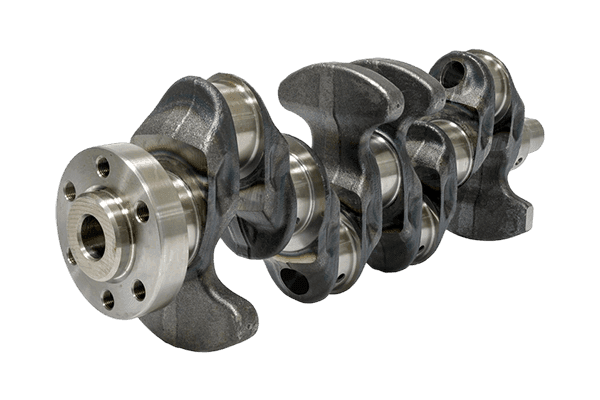
Ask the workshop to record measured clearances, journal condition and the specification used to judge them. The diesel engine block inspection tasks treat journals, bearings and oil passages as distinct inspection items. Do not expand an order to include a crankshaft on the strength of a warning alone.
If inspection does justify replacement, use our engine crankshaft matching guidance to organize the engine identity, journal requirements and connection details. Confirm any previous machining rather than assuming standard dimensions.
Also distinguish the original cause of low oil pressure from damage sustained afterward. Both may need correction, but they should not be described as the same failure.
Revisit Recent Service or Rebuild Work
When low oil pressure appears after maintenance, start with a clear account of the work performed. Identify the oil and filter installed, the seals and connections disturbed, and any pump or bearing-related changes.
After a rebuild, compare the assembly record with the prescribed lubrication preparation and commissioning procedure. Ask whether the required plugs, passages and installed clearances were verified. Do not substitute a generic priming method or repeated cranking for the specified procedure.
For repairs also involving the cylinder group, our piston and liner matching guide keeps component identity, measured fit and supply scope separate. Those approvals remain necessary, but they do not prove the lubrication system is ready.
A fault appearing after service is a reason to examine what changed, not proof that a particular new part is defective.
What Evidence Supports Oil Pump Replacement
The strongest replacement decision combines a confirmed lubrication problem with findings that the applicable service procedure identifies as pump failure. Depending on the design, those findings might involve drive damage, housing or rotor damage, measured wear beyond a service limit, or a failed integrated regulating function.
For low oil pressure, ask for the actual finding rather than the phrase “weak pump.” Record which feature failed inspection, how it was checked, the relevant limit and the technician’s conclusion.
The repair scope must also address why that failure occurred. Debris damage, for example, raises a separate question about the contamination source and affected oil circuit. An acceptable replacement part is only one part of an acceptable repair.
Keep diagnosis approval and purchase approval as separate decisions, with one responsible person identified for each.
Match the Replacement to the Actual Engine
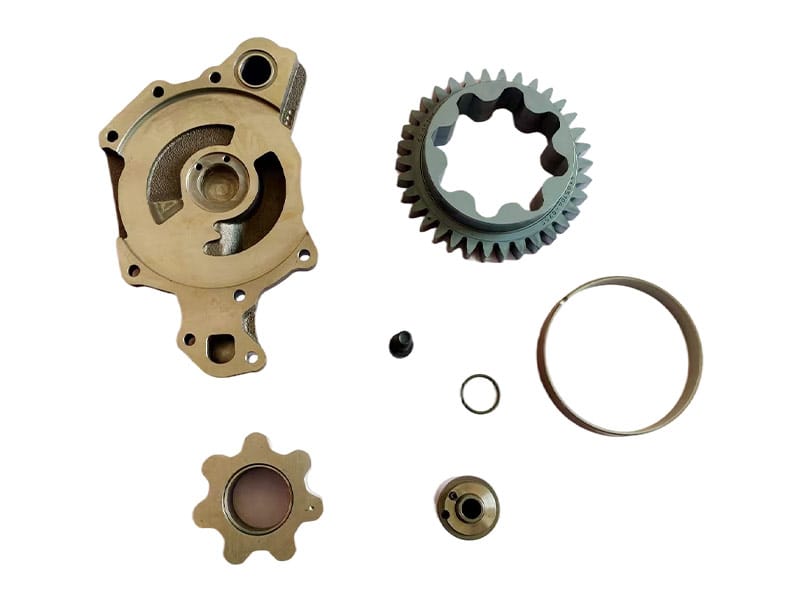
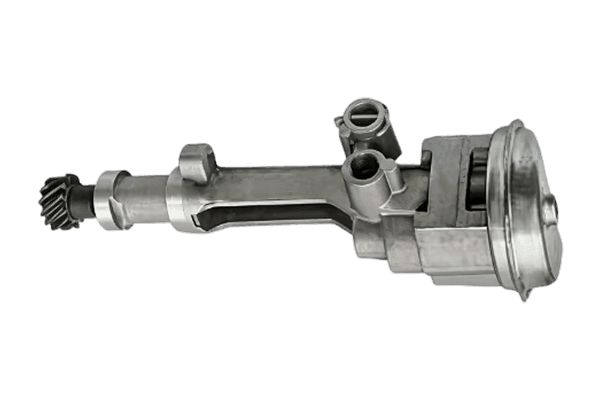
Once pump replacement is justified, match the proposed part to the engine rather than to a general truck description. Our engine oil pump product page requests the engine code, pump reference, mounting face, drive arrangement and oil-port layout.
Use the following purchasing record after the low oil pressure diagnosis has established the repair requirement.
| Approval item | What the buyer should provide or confirm | Unresolved risk |
|---|---|---|
| Engine identity | Complete engine code, serial information and readable identification photographs | A truck model alone does not identify every engine variant |
| Part reference | Old reference, proposed reference and documented substitution where relevant | Similar markings may be mistaken for interchangeability |
| Mechanical interfaces | Mounting face, drive connection, oil ports and relevant drawing | A similar outline can conceal an incompatible connection |
| Functional requirement | Applicable engine specification and its stated operating conditions | Unqualified performance claims cannot establish suitability |
| Supply contents | Itemized pump, seals, gaskets, drive parts and other requested accessories | A photograph may show items not included in the shipment |
| Order identity | Approved quantity, reference revision and destination | Correct technical approval can be lost during order processing |
Overall dimensions and packed weight do not establish oil-flow or pressure performance. Where functional data is needed, confirm what evidence applies to the offered reference before approving the order.
Define the Supplied Components and Test Evidence
A low oil pressure repair can be delayed by an omitted seal just as easily as by a wrongly identified pump. Make included and excluded components explicit instead of relying on “complete assembly” in a quotation.
Separate a dimensional inspection record from a functional test report. When requesting test evidence, ask which part or batch was tested, what conditions applied and which acceptance requirement was used. A statement that an item was “checked” does not answer those questions.
Ask for the test fluid, temperature, pump speed and pressure conditions alongside any reported flow result. These details let the technical reviewer judge whether a report answers the required performance question. Keep bench-test acceptance separate from installed-engine acceptance: one concerns the supplied component, while the other concerns the repaired lubrication system. For low oil pressure repairs, neither a packing label nor a standalone inspection stamp should replace that distinction. Any acceptance claim should identify exactly what was verified.
Do not assume accessories, test records or a particular configuration are available until confirmed for the order. Give the supplier a precise requirement and keep pending answers visible. This makes technical approval easier to trace if the quotation changes before dispatch.
Verify the Repair Before Returning to Work
Closing a low oil pressure repair requires more than extinguishing a warning. The workshop should complete the specified commissioning and verification procedure, confirm relevant readings under approved conditions, and document any unresolved findings.
Do not compare a cold post-repair reading with a hot pre-repair reading and call the difference proof of success. Preserve the test conditions alongside both results.
The handover record should explain the diagnosed cause, the corrected fault, the installed references and the basis for return to service. When low oil pressure involved contamination or wider damage, include the related corrective work. Purchasing can then close the order against the approved repair scope rather than a dashboard photograph.
Conclusion
Low oil pressure calls for verification before replacement. Separate the pressure indication from the actual lubrication condition, investigate the cause and authorize only the parts supported by inspection.
When the workshop confirms a replacement requirement, contact Cheyu for an engine oil pump matching review. Send the complete engine code, existing part reference, interface photographs, inspection findings, required components and quantity. That information supports a specific quotation without treating a warning light as a parts diagnosis.
FAQ
Can a truck keep driving with low oil pressure?
Do not continue operating with an active pressure warning. Stop safely, shut down according to the vehicle instructions and arrange assessment. Normal engine sound does not establish safe lubrication.
Why is there low oil pressure when the oil level is full?
Level and pressure measure different conditions. A full sump does not rule out an indication fault, unsuitable or contaminated oil, interrupted supply, regulating problems, excessive internal leakage or pump damage.
Does low oil pressure at hot idle mean the pump is worn?
Not by itself. Compare an independently verified reading with the engine’s specified requirement at the stated speed and temperature. Several lubrication or sensing faults can produce a similar complaint.
Can a pressure sensor cause a false warning?
Yes, but confirm that conclusion through the applicable diagnostic procedure. A dashboard display and scan-tool reading may share one signal. Neither should replace the required independent pressure check.
Will a new oil pump always fix low oil pressure?
No. A new pump does not correct an unresolved pickup fault, contamination source or excessive bearing clearance. Confirm the cause, repair the affected system and verify the result before returning the truck to work.